
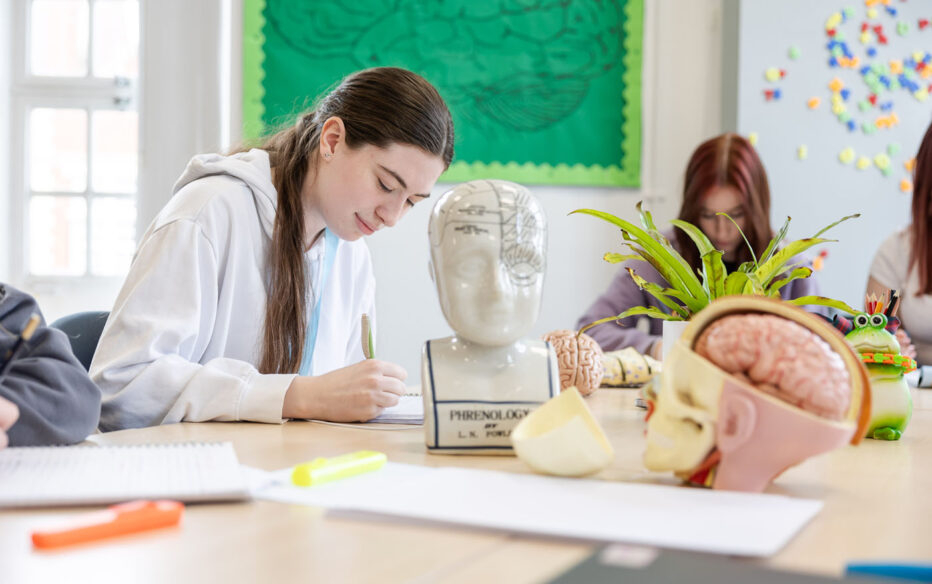
Our AAQ in Mental Health: Individual and Societies explores the factors that influence mental health and wellbeing at both individual, community and wider-society levels. Learners study the fundamentals of mental health, community and organisational support, and the importance of key factors such as the role of physical activity in promoting positive wellbeing. The qualification develops key academic skills such as critical thinking, research, communication, reflection and analysis, crucial in preparing students for higher education and the workplace. It also provides a strong foundation for future careers within psychology, mental health nursing, counselling, social work, youth support, occupational therapy and community wellbeing, supporting progression into roles that promote positive mental health and wellbeing.
You will need 5 GCSEs at Grade 4 or above, including Maths & English Language
The course is graded A*-E and each grade is worth the following UCAS points:
- Grade A = 56 UCAS points
- Grade B = 48 UCAS points
- Grade C = 32 UCAS points
- Grade D = 24 UCAS points
- Grade A = 12 UCAS points
| Study level | Cost | Additional fees |
|---|---|---|
| 16-18 | Free | There are no costs charged to enable you to study this course, although there may be a cost associated with any external trips/visits. You will need to provide your own stationery, and you may wish to purchase core textbooks/revision guides. |
40% externally-assessed examinations and 60% internally-assessed assignments.
You will complete one externally-examined unit and one internally-assessed unit in each year of this two-year course.
Year 1:
External Exam – Unit 1: Fundamentals of Mental Health and the Individual
Internal Assignment – Unit 3: Supporting and Promoting Mental Health & Wellbeing in Organisations
Internal Assignment – Unit 4: Community-based Support for Mental Health & Wellbeing
Year 2:
External Exam – Unit 2: Mental Health, Wellbeing and Society
Internal Assignment – Unit 5: Supporting Mental Health & Wellbeing with Physical Activity
GCSE Maths and English are vital stepping stones for your academic and professional journey. Achieving a good grade in these subjects not only fulfils most college entry requirements but also equips you with essential skills critical in almost every field. Whether you're calculating percentages in business, crafting compelling arguments, or simply managing daily tasks, these core subjects enhance your problem-solving and communication abilities, setting a solid foundation for your future studies and career success. Start your college course with confidence by securing these key qualifications before you enrol.
At Northumberland College our commitment to your future goes beyond the classroom. We are dedicated to providing you with real-world experiences and industry insights that will prepare you not just to enter, but to excel in your chosen field. Here’s how we connect you with the industry:
• Placement Opportunities: Dive into your future career with our hands-on placement opportunities. These are not just work experiences, but gateways to potential employment and invaluable learning. They’re a core part of our courses, offering you a chance to apply academic theories in real-world scenarios.
• Networking Events: Build your professional network early. Our placement and careers fairs are your chance to meet and impress potential employers. These events are designed to help you forge significant industry connections that can enhance your career prospects. Attend talks, engage in discussions, and explore apprenticeship opportunities with employers who are eager to meet fresh talent.
• Expert Insights: Stay ahead of the curve with talks from specialist speakers. These industry leaders share the latest trends, challenges, and opportunities in the field, giving you the inside track on what to expect and how to thrive.
• Skills Competitions: Showcase your abilities in our exciting skills competitions. Held throughout the academic year, these competitions are not just about winning – they are about learning, growing, and pushing your limits. They offer a fun, competitive environment to enhance what you learn in class and develop essential industry skills.
You will study 3 A Level (or equivalent) subjects over two years, with each subject taught for 4 hours 30 minutes per week across three separate lessons.Your timetable will be determined by your three chosen subjects.
Although you are not required to be on campus when you do not have a timetabled lesson, we strongly recommend making effective use of our learning facilities and resources during these study periods to stay on top of your work.
Modules/course content:
Unit 1: Fundamentals of Mental Health and the Individual
Explores the core concepts of mental health, including definitions, types of mental ill health, and factors that influence mental wellbeing. Learners examine how biological, psychological, and social factors interact to affect an individual’s mental health. It also looks at stigma, discrimination, and the importance of early intervention and self-awareness.
Unit 2: Mental Health, Wellbeing and Society
Focuses on the wider social and cultural influences on mental health. It examines how communities, media, economic conditions, education, and government policies impact wellbeing. Learners consider social attitudes toward mental health and the importance of creating inclusive, supportive environments that promote societal wellbeing.
Unit 3: Supporting and Promoting Mental Health & Wellbeing in Organisations
Investigates the role that organisations play in supporting mental health. Learners explore workplace wellbeing strategies, policies, and initiatives that promote a positive culture. The unit highlights leadership responsibilities, mental health awareness training, and the importance of safe, supportive working environments.
Unit 4: Community-based Support for Mental Health & Wellbeing
Examines the variety of community-based services and approaches available to support individuals’ mental health. Learners study statutory, voluntary, and informal support networks, as well as partnership working among agencies. It emphasizes community engagement, accessibility, and the role of social inclusion in recovery and wellbeing.
Unit 5: Supporting Mental Health & Wellbeing with Physical Activity
Explores the connection between physical activity and mental health. Learners investigate how exercise can prevent or alleviate mental ill health, improve mood, and enhance resilience. The unit covers practical ways to encourage participation, design inclusive activity programmes, and understand the physiological and psychological benefits of movement.
Studying an AAQ in Mental Health will provide an excellent foundation for progressing into higher education and diverse careers within the Health & Social Care and Health Sciences sectors. Learners can advance to university degrees such as Psychology, Mental Health Nursing, Social Work, Counselling or Health and Wellbeing. These pathways open opportunities to work in roles including mental health practitioner, wellbeing coordinator, occupational therapist, youth support worker, psychological wellbeing practitioner, health promotion specialist, community outreach officer or rehabilitation worker. Students may also pursue careers in education, public health, the charity sector or community initiatives development. Building on this qualification equips learners with the knowledge, empathy and practical understanding essential for supporting others and promoting positive mental health for individuals and across communities.
Find out everything you need to know about Northumberland College and our exciting range of courses!
Pre-register for our next open event


Rated Outstanding in all areas by Ofsted
2024

Top land-based college in the North East

100% pass rate for equine management and floristry courses

Our extensive re-development programme will create outstanding new facilities